Dynamic QR Code Pricing: 12 Platforms Compared (2026)

Key Takeaway
Compare dynamic QR pricing across 12 platforms, including free allowances, scan conditions, billing terms, and QRLynx plans. Prices checked July 2026.
Pricing checked: July 2026
We checked the public pricing and policy pages linked below in July 2026. Prices exclude taxes unless a provider says otherwise. A monthly equivalent can still require an annual payment upfront, and plan allowances can change after publication.
Selected pricing and allowance updates were verified on September 7, 2026. Annual totals calculated from a displayed monthly equivalent are identified below. Confirm the checkout total, currency, and applicable taxes before purchasing. QRLynx publishes this guide about its own product and other providers; see our research methodology.
Dynamic QR code pricing starts at $0, while common entry plans in this comparison range from about $5 to $25 per month or monthly equivalent. The useful comparison is not price alone. Check how many dynamic codes stay active, whether scans or analytics are capped, whether the displayed rate requires annual prepayment, and what happens after a trial, cancellation, or downgrade.
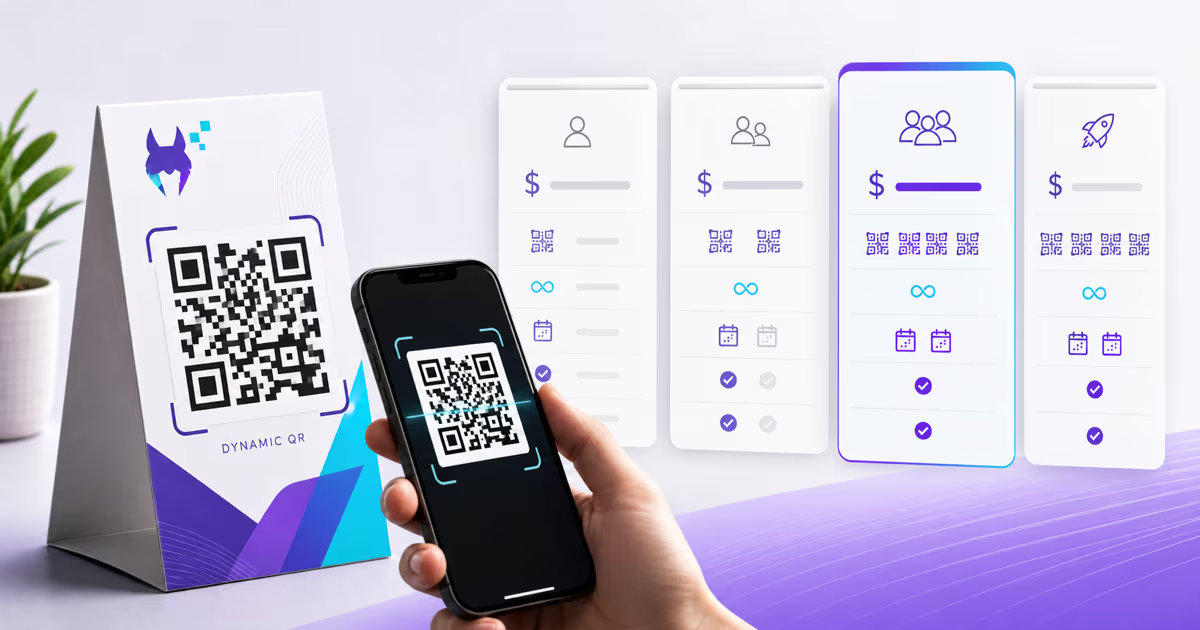
QRLynx's free Starter plan includes 3 active dynamic QR codes with unlimited scans and three months of analytics. Starter+ costs $7 per month for 50 active dynamic codes. QRLynx also has Pro, Business, and Enterprise plans for campaigns, teams, API access, analytics controls, and white-label scale.
Why dynamic QR services have recurring prices
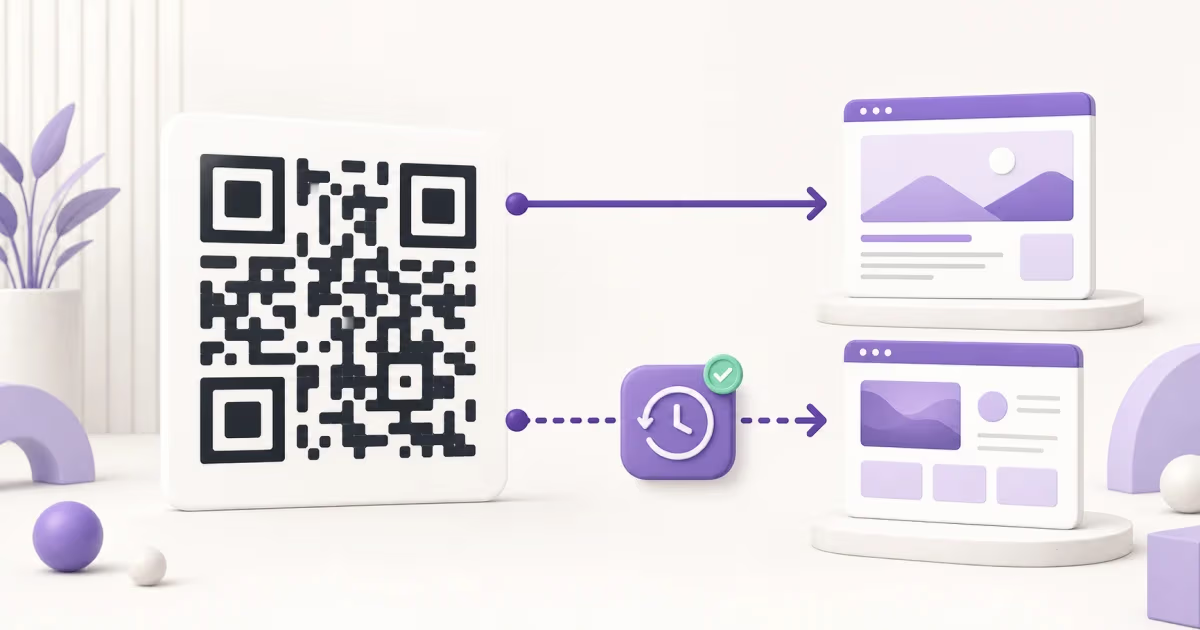
A static QR stores its final payload directly in the symbol. A dynamic QR normally stores a provider-managed short URL. Each scan reaches that service before the visitor is sent to the current destination.
The managed redirect enables destination changes after printing and eligible scan analytics. It also creates continuing infrastructure, security, storage, and support work for the provider. Plans package those services through code allowances, scan or analytics limits, team seats, retention windows, bulk tools, custom domains, and other controls.
For printed campaigns, evaluate the continuing redirect policy as carefully as the creation price. The most suitable plan is the one whose active-code and scan conditions match the intended lifetime and traffic of the material.
Dynamic QR pricing across 12 platforms
| Platform | Free dynamic access | Starting paid dynamic offer | Important condition |
|---|---|---|---|
| QRLynx | 3 active codes on the free Starter plan | Starter+ at $7/month for 50 active codes | Unlimited scans on every plan; three months of analytics on the free Starter plan and one year on Starter+ |
| Trimrly | 20 QR codes created per calendar month | No published paid-plan price; advanced plans are described as future options | The public page describes editable codes, unlimited clicks, no card, and no expiry |
| Hovercode | 3 dynamic QR codes in total | $12/month for 100 dynamic codes | Free includes unlimited scans and three months of basic analytics |
| QR TIGER | 3 dynamic QR codes | Regular at $7/month or $65/year for 12 dynamic codes | Free allows 500 scans per dynamic code and shows a QR TIGER logo popup |
| QRCodeChimp | 10 dynamic QR codes | $9.99 monthly or $6.99/month with annual billing for 50 codes | Free pools 1,000 scans/month and Starter pools 10,000; dynamic scans pause at the monthly limit |
| Flowcode | 2 Flowcodes | Pro Plus at $60/month or $300/year for 50 codes (annual total calculated from $25/month billed annually) | Free has 500 analytics scans across the account; Pro Plus lists 6,000. Codes keep resolving after the analytics cap; free output carries Flowcode branding |
| QRFY | 7-day trial | $19/month equivalent when $228 is paid annually | Paid plans advertise unlimited dynamic codes and scans; no month-to-month option was shown |
| Uniqode | 14-day dynamic trial; static creation remains available | From $9/month with annual billing | Trial dynamic codes become inactive without a paid plan, and scan allowances reset annually |
| Kaywa | No public permanent dynamic plan confirmed on the current pricing page | $13.75/month billed annually for 5 dynamic codes | The next 50-code plan is $37.50/month annually or $45 month-to-month |
| Scanova | No permanent free dynamic plan on the current pricing schedule | $5/month billed annually for 3 dynamic codes | A $150 one-time option covers one lifetime dynamic code; subscription plans list unlimited scans |
| Delivr | 90-day trial with 3 dynamic-ready codes; upgrade required for destination editing | PLUS at $25/month or $270/year for 100 dynamic codes | Trial has 1,000 total views. PLUS monthly has 25,000 views/month, then $0.001 per additional view; annual has 300,000 views/year, then the same overage |
| True QR Code | No permanent free plan shown on the checked pricing page | Basic: 2 dynamic codes and 250 scans/month; annual billing, currency and total to confirm at checkout | Pro lists 50 dynamic codes and 1,500 scans/month; Business lists unlimited codes and scans. The checked cards omitted a currency symbol |
What QRLynx provides at each stage
The free Starter plan is the QRLynx entry point for individuals and small permanent placements. It includes 3 active dynamic codes, unlimited scans, three months of analytics, design customization, and registered downloads without a QRLynx watermark or monetization ad interstitial.
Starter+ costs $7 per month and raises the active dynamic allowance to 50. It also adds one year of analytics, resolution-independent SVG artwork, A4 PDF downloads containing a high-resolution QR image, and Full AI Insights.
Pro costs $14 per month for 300 dynamic codes and includes two years of analytics, dynamic bulk creation, and country analytics plus controls such as password protection, smart redirect rules, consent screens, expiry rules, and scheduling.
Business costs $29 per month for 1,000 dynamic codes and includes three years of analytics, team workspaces, city and device analytics, CSV export, lead forms, public API access, and larger dynamic bulk batches. Enterprise costs $99 per month for 5,000 codes and adds no fixed plan cap on available analytics history, eligible custom dynamic QR domains and white-label features, retargeting, larger teams, and higher-volume bulk work.
Which QRLynx plan fits the job?
| Your requirement | Lowest qualifying QRLynx plan | Why this tier fits |
|---|---|---|
| A few editable links with scan tracking | The free Starter plan, $0 | Up to 3 active dynamic codes, unlimited scans, and three months of analytics. |
| 20 editable codes with SVG artwork for printing | Starter+, $7/month or $70/year | 50 active slots and SVG downloads. A4 PDF downloads and one year of analytics are also included. |
| 20 editable codes with passwords or a schedule | Pro, $14/month or $140/year | Passwords and scheduling require Pro even though 20 codes fit within Starter+ capacity. |
| Create 20 saved dynamic codes from one CSV | Pro, $14/month or $140/year | Dynamic bulk starts on Pro: up to 100 codes per batch and five batches per month, within 300 active slots. The free static bulk tool is a separate workflow. |
| A team workspace or public API access | Business, $29/month or $290/year | Business adds up to 10 team members, public API access, CSV analytics export, and 1,000 active dynamic slots. |
| An eligible custom domain for dynamic QR links | Enterprise, $99/month or $990/year | Enterprise includes eligible custom-domain setup and 5,000 active dynamic slots. The domain must be configured and activated. |
Choose the QRLynx tier that covers both your active-code count and your required features. A small code count can still need a higher plan for passwords, bulk creation, teams, or a custom domain. If you only need more active codes, the capacities are 50 on Starter+, 300 on Pro, 1,000 on Business, and 5,000 on Enterprise. Scans are unlimited across the plans.
Use these examples to shortlist a tier, then compare QRLynx plans and billing options. Eligible controls apply to supported dynamic QR workflows.
How to create and price a dynamic QR campaign in QRLynx
Build one verified code first, then choose capacity from the campaign you actually plan to run.
List the destinations and printed placements
Count the distinct web destinations that must remain editable after printing. Record the expected campaign duration, approximate scan volume, number of collaborators, and whether each printed placement needs its own analytics.
Choose Website / Link in QRLynx
Open the QRLynx generator and select Website / Link for a standard editable web destination. Enter the final destination and choose dynamic behavior so the printed QR uses a managed short link rather than storing the destination directly.
Design and label the scan action
Use strong contrast, preserve the quiet zone, and add a short frame label that tells the scanner what opens. Give the saved QRLynx record a useful campaign name before downloading it.
Test the redirect and physical proof
Scan the downloaded image, confirm the final destination, then test one physical proof on representative phones, materials, distances, and lighting. A successful dashboard preview does not replace testing the printed result.
Match the QRLynx plan to active capacity
Start with the free Starter plan when 3 active dynamic codes are enough. Move to Starter+, Pro, Business, or Enterprise only when the required code count, analytics, controls, team access, API, bulk workflow, or white-label needs justify it.
Monitor and review before renewal
Confirm that every printed code remains active, review scan activity within the plan's analytics window, archive unused test records, and check the current pricing page before changing plans or committing to a new billing interval.
Campaign scope ready
Create the first dynamic QR in QRLynx
Build and test one editable Website / Link QR, then choose the plan that fits the real active-code count.
Five conditions to compare before choosing a plan
| Condition | What to verify | Why it matters after printing |
|---|---|---|
| Active dynamic allowance | Total active codes, monthly creation allowance, or both | A monthly creation allowance and a total active-code allowance solve different campaign needs |
| Scan behavior | Per-code, pooled-account, monthly, annual, or analytics-only limit | Some limits pause redirects while others only stop collecting new analytics |
| Billing interval | True month-to-month price and total annual payment | A low monthly equivalent can require a larger upfront commitment |
| Trial and downgrade policy | What remains active after trial, cancellation, or downgrade | The printed pattern cannot be replaced remotely when its managed redirect becomes inactive |
| Included operations | Analytics depth, retention, teams, bulk, API, custom domains, and export | The cheapest code count may not include the workflow the campaign actually requires |
Compare scan caps and analytics caps separately
A scan cap can describe different outcomes. QRCodeChimp says its free account pools 1,000 monthly scans across all dynamic codes and pauses scans when the pool is reached. QR TIGER publishes a 500-scan allowance for each free dynamic code. True QR Code currently lists monthly scan allowances for Basic and Pro.
Flowcode uses a different model on its free plan: its code continues resolving after the first 500 scans, but later scans no longer appear in the dashboard. That is an analytics cap rather than a redirect cap. Ask what the scanner experiences after the number is reached instead of treating every limit as the same.
QRLynx does not impose plan-based scan caps. Analytics access still varies by plan and retention window, and abuse protection can apply to malicious traffic. The distinction is important: unlimited scans describes redirect availability, not unlimited detail or permanent retention of every analytics record.
Convert annual rates into the amount charged
Several platforms display a monthly equivalent while charging for a full year. For example, a page can show $9 per month and still require $108 at checkout. Record both figures before comparing it with a true month-to-month plan.
QRLynx offers monthly billing at the published monthly prices and a separate yearly option. Scanova and Uniqode publish annual-only entry subscriptions. Kaywa publishes both an annual equivalent and month-to-month pricing for some tiers. QRFY publishes quarterly, six-month, and annual terms rather than a month-to-month subscription.
Annual billing can be useful after a platform and campaign are proven. For a first print run, a shorter commitment keeps the evaluation cost aligned with the evidence you have.
QRLynx monthly payments versus annual payment
| Plan | Pay monthly | Pay once for the year | 12 monthly payments | Annual saving over 12 months |
|---|---|---|---|---|
| Starter+ | $7/month | $70 | $84 | $14 |
| Pro | $14/month | $140 | $168 | $28 |
| Business | $29/month | $290 | $348 | $58 |
| Enterprise | $99/month | $990 | $1188 | $198 |
These QRLynx subscription calculations use the published prices before any applicable taxes or discounts. An annual payment equals ten monthly payments on every paid tier. For example, three monthly payments on Starter+ total $21, while a year costs $70 upfront. Twelve monthly payments total $84, so yearly billing saves $14 over a full year.
Plan the billing period around how long the printed QR links need to stay active with their paid features. A three-month promotion can have a longer useful life if its labels or brochures remain in circulation. These budget examples do not change renewal, cancellation, or refund terms.
Estimate cost from the whole campaign
Count only the dynamic codes that need independent destinations or analytics. Ten posters that all open the same destination can share one QR image when separate placement attribution is unnecessary. When each placement needs its own reporting, each one needs a distinct dynamic record.
- Personal or test use: compare permanent free allowances, scan behavior, and whether the output carries a scanner-facing ad or provider mark.
- Small printed campaign: compare 50-code pricing, vector downloads, analytics retention, and the cost of true monthly billing.
- Growing campaign: compare hundreds of codes, bulk creation, country and device detail, rules, export, and API access.
- Team or agency: compare seats, roles, workspace ownership, client separation, and audit controls.
- Enterprise deployment: compare custom redirect domains, white-labeling, support, security review, migration planning, and contract terms.
The subscription is one part of the campaign cost. Include design, printing, replacement labor, destination maintenance, and the operational cost of a redirect becoming inactive.
100 printed copies can use one active code
If 100 menu cards all open the same page and you only need combined scan reporting, they can share one dynamic QR image. That uses one active QRLynx slot and fits the free Starter plan when its other features meet the job. Printing more copies does not itself consume more active slots.
100 separately tracked placements need 100 active codes
If you want to compare each placement in QRLynx, give each one its own dynamic record. One hundred active records exceed Starter+ capacity and fit Pro at $14 per month or $140 per year. Pro also supports creating those 100 records in one dynamic bulk batch. For a three-month paid period, three monthly payments total $42 before any applicable taxes or discounts.
Reusing one dynamic record for a later campaign keeps that same active slot. Creating a new record while keeping the earlier one active uses another slot. Count everything that must remain active together, rather than assuming the allowance resets each month. For a like-for-like multi-provider buying comparison, see our dynamic QR code generator comparison.
Official pricing sources
- QRLynx pricing
- Trimrly pricing
- Hovercode pricing
- QR TIGER pricing
- QRCodeChimp pricing
- Flowcode pricing
- QRFY pricing
- Uniqode pricing
- Kaywa pricing
- Scanova pricing
- Delivr pricing
- True QR Code pricing
Provider names and marks belong to their respective owners. Recheck the linked page and checkout total before purchasing.
Dynamic QR pricing questions
Answers about QRLynx pricing, free dynamic codes, billing terms, scan limits, and campaign sizing.
How much does a dynamic QR code cost?
Dynamic QR pricing starts at $0. Common entry offers in this 12-platform comparison range from about $5 to $25 per month or monthly equivalent, while team and enterprise plans cost more. Compare code allowance, scans, analytics, billing term, and post-cancellation behavior together.
Does QRLynx have a free dynamic QR plan?
Yes. The free QRLynx Starter plan includes 3 active dynamic QR codes, unlimited scans, three months of analytics, design customization, and registered downloads without a QRLynx watermark or monetization ad interstitial.
What does QRLynx Starter+ cost?
QRLynx Starter+ costs $7 per month or $70 per year and includes 50 active dynamic QR codes, one year of analytics, Full AI Insights, resolution-independent SVG artwork, and A4 PDF downloads containing a high-resolution QR image.
Why do dynamic QR codes have recurring prices?
A dynamic QR normally sends each scan through a managed redirect service. The recurring plan supports destination editing, redirect infrastructure, eligible analytics, security, storage, and account operations after the image is printed.
Does unlimited scans mean unlimited analytics?
No. Unlimited scans describes whether the redirect remains available under normal plan use. Analytics dimensions, retention windows, exports, and individual-event detail can still vary by plan.
What is the difference between a scan cap and an analytics cap?
A scan cap may stop or pause the redirect when reached. An analytics cap can let the code keep resolving while later scans stop appearing in reports. Verify the scanner-facing outcome in the provider's current policy.
How should I compare annual and monthly QR pricing?
Record the displayed monthly equivalent, the actual amount charged at checkout, the renewal interval, and whether a true month-to-month option exists. A $9 monthly equivalent can still require a $108 annual payment upfront. For QRLynx Starter+, monthly billing is $7 per payment, while annual billing is $70 upfront. Twelve monthly payments total $84, so annual billing saves $14 over a full year before applicable taxes or discounts.
How many dynamic QR codes does a small business need?
Count distinct destinations and any placements that need separate analytics. Multiple identical prints can share one QR when they use the same destination and do not require placement-level attribution. For example, 100 identical menu cards can share one active code, while 100 placements with separate QRLynx reporting need 100 active records. QRLynx active-code allowances do not reset monthly.
What happens to a printed dynamic QR after a trial ends?
The outcome depends on the provider. Some trial codes become inactive, while a permanent free allowance may keep selected codes active. Confirm the exact trial, downgrade, and cancellation policy before printing.
Which QRLynx plan supports teams and API access?
QRLynx Business costs $29 per month or $290 per year and includes team workspaces, public API access, dynamic bulk creation, city and device analytics, CSV export, and 1,000 active dynamic codes. Enterprise extends the platform for larger teams and eligible custom dynamic QR domains.
Can I create a QRLynx dynamic QR before paying?
Yes. Create a free Starter account, choose Website / Link, select dynamic behavior, save the code, design it, and test the redirect and physical proof. Upgrade only when the required active-code capacity or paid capabilities justify it.
When were these prices checked?
The original pricing review was in July 2026, with selected pricing and allowance updates verified on September 7, 2026. Linked sources identify the providers. Confirm current checkout totals, currencies, and taxes before purchasing; no purchase or cancellation test was performed for this update.