Create a PayPal QR Code (Free, 2026) — Accept Payments in 60 Seconds

Key Takeaway
How to create a free PayPal QR code for business or personal payments in 60 seconds. Works for friends & family, in-store checkout, invoices, and donations — with scan tracking.
Why PayPal QR Codes Are Reshaping Contactless Payments
The way consumers pay for goods and services has changed dramatically. According to Statista, global mobile payment transaction volume surpassed $2.1 trillion in 2025 and is projected to exceed $2.8 trillion by 2027. Contactless payments — including QR code payments — now account for more than 40 percent of all in-person transactions in markets like China, India, and Southeast Asia, and adoption across North America and Europe is accelerating rapidly. PayPal, with over 430 million active accounts worldwide according to its 2025 annual report, sits at the center of this shift.
A PayPal QR code lets customers pay you by scanning a code with their phone camera or the PayPal app. No card reader hardware, no terminal rental fees, no tapping a physical card. The customer scans, confirms the amount, and the money lands in your PayPal account within seconds. For small businesses, freelancers, event vendors, nonprofits, and anyone who needs to accept money without expensive point-of-sale infrastructure, PayPal QR codes offer a remarkably low-friction solution.
But not all PayPal QR codes are created equal. PayPal offers multiple QR-based payment methods — PayPal.me personal links, PayPal Business QR codes in the PayPal app, and PayPal Zettle for retail — and each comes with different fee structures, features, and limitations. Meanwhile, competitors like Venmo, Cash App, Square, and Stripe also offer QR payment options, each with their own trade-offs. This guide walks you through every option, compares them side by side, and shows you step by step how to create, customize, and track a PayPal QR code that works for your specific use case — whether you are running a coffee cart at a farmers market, collecting donations for a nonprofit, invoicing freelance clients, or accepting payments at a pop-up retail event.
PayPal.me Links vs PayPal Business QR Codes: Understanding Your Options
PayPal provides two primary ways to accept payments via QR code, and the differences matter significantly for fees, functionality, and professionalism.
Option 1: PayPal.me Personal Link
PayPal.me is a personalized payment link in the format paypal.me/YourName. When someone visits this URL, they see your name and profile photo and can enter any amount to send you. You can also append a specific amount to the URL: paypal.me/YourName/25 pre-fills a $25 payment. Converting this URL into a QR code is straightforward — paste the PayPal.me URL into any QR code generator like QRLynx, and you have a scannable payment code. PayPal.me works with both personal and business accounts. When the sender pays via the "Friends and Family" option, there is no transaction fee. When they pay via "Goods and Services," PayPal charges its standard processing rate.
Option 2: PayPal Business QR Code (In-App)
PayPal's native business QR code is generated directly inside the PayPal app or PayPal Business app. This code is tied to your PayPal business account and is designed for in-person transactions. The customer opens their PayPal app, scans your code, enters the payment amount, and confirms. PayPal has historically offered promotional rates for in-person QR code transactions — as low as 1.90 percent plus a fixed fee per transaction for eligible merchants in the US — compared to the standard 2.99 percent for online payments. Check PayPal's current QR code pricing page for the latest rates, as promotional pricing changes periodically.
Option 3: PayPal Zettle (Point of Sale)
PayPal Zettle (formerly iZettle) is PayPal's dedicated point-of-sale solution for retail businesses. It includes a card reader, inventory management, and receipt printing. Zettle supports QR code payments through the app and is best suited for established retail locations that need full POS functionality. Transaction fees are typically 2.29 percent plus $0.09 per transaction for in-person payments.
Which Option Should You Choose?
For casual person-to-person payments, event tips, and simple donations, a PayPal.me QR code is the easiest path. For regular business transactions at a physical location, the PayPal Business QR code offers lower fees and a more professional payment flow. For retail stores needing inventory tracking and receipt management, Zettle is the full-featured solution. The comparison table below summarizes the key differences.
Feature Comparison
| Feature | PayPal.me Link | PayPal Business QR | PayPal Zettle |
|---|---|---|---|
| Setup complexity | Minimal — just a URL | Moderate — requires Business account | Higher — hardware and software setup |
| Transaction fee (US in-person) | 0% (Friends/Family) or 2.99% (G&S) | 1.90% + fixed fee (promotional) | 2.29% + $0.09 |
| Customer needs PayPal app | No — opens in browser | Yes — must have PayPal or Venmo app | No — accepts cards + QR |
| Custom payment amounts | Pre-set or customer enters | Customer enters amount | Merchant sets amount |
| Invoice integration | |||
| Inventory management | |||
| Receipt generation | Email confirmation only | Email confirmation | Printed + email receipts |
| Best for | Freelancers, tips, donations | Farmers markets, pop-ups, services | Retail stores, restaurants |
PayPal QR Codes vs Venmo, Cash App, Square, and Stripe
PayPal is not the only platform offering QR-based payments. Understanding how it stacks up against competitors helps you choose the right solution — or decide to offer multiple options. Here is a detailed comparison of the five most popular payment platforms that support QR codes in 2026.
Comparison Table
| Platform | QR Code Type | In-Person Fee (US) | Online Fee (US) | Payer Needs App? | International Payments | Business Features |
|---|---|---|---|---|---|---|
| PayPal Business QR | In-app generated | 1.90% + fixed | 2.99% + fixed | Yes (PayPal/Venmo) | Yes (200+ markets) | Invoicing, reporting, Zettle POS |
| PayPal.me Link | URL-based (any generator) | 0% (F&F) / 2.99% | 2.99% + fixed | No (browser) | Limited | |
| Venmo QR | In-app generated | 1.90% + $0.10 | 2.99% + $0.49 | No (US only) | Business profiles, social feed | |
| Cash App QR ($Cashtag) | In-app generated | 2.75% | 2.75% | No (US + UK only) | Basic reporting | |
| Square QR | POS-generated | 2.60% + $0.10 | 2.90% + $0.30 | No (browser) | Limited | Full POS, inventory, payroll |
| Stripe Payment Links | URL-based (any generator) | 2.90% + $0.30 | 2.90% + $0.30 | No (browser) | Yes (135+ currencies) | Subscriptions, API, invoicing |
PayPal vs Venmo: Venmo is owned by PayPal and offers similar QR code payment functionality. The key difference is audience: Venmo skews younger (18-34 demographic) and is US-only, while PayPal operates in over 200 countries and territories. Venmo business profiles include a social feed component where transactions can appear publicly, which some businesses see as free marketing. Both platforms offer the same promotional in-person QR rate of 1.90 percent.
PayPal vs Cash App: Cash App (by Block, formerly Square Inc.) offers a simpler QR code payment experience through $Cashtag codes. The flat 2.75 percent fee for business accounts has no per-transaction fixed cost, which can be cheaper for very small transactions. However, Cash App lacks international support (US and UK only) and has fewer business features than PayPal.
PayPal vs Square: Square is the stronger choice for brick-and-mortar retail thanks to its comprehensive POS system, hardware options, and inventory management. For pop-up vendors, farmers market sellers, and mobile businesses that do not need full POS infrastructure, PayPal's lower QR code transaction fees make it more cost-effective. Square's QR code payments work through the browser, meaning the customer does not need a specific app — a significant advantage over PayPal's in-app QR code.
PayPal vs Stripe: Stripe Payment Links can be turned into QR codes using any URL-based generator. Stripe is the developer-friendly choice with superior API access, subscription management, and webhook integrations. For businesses that need programmatic payment processing or run a SaaS product, Stripe is the better platform. For individuals, small businesses, and in-person transactions, PayPal is simpler and has a much larger consumer user base.
Multi-Platform Strategy: Many businesses offer multiple payment QR codes side by side. A farmers market vendor, for example, might display a PayPal QR code, a Venmo QR code, and a Cash App QR code on a single printed sign — letting the customer choose their preferred app. Use QRLynx to create branded QR codes for each platform, all with consistent design and scan tracking.
Static vs Dynamic PayPal QR Codes: Which Should You Use?
When creating a QR code for PayPal payments, you face a fundamental choice between static and dynamic codes. This decision affects your ability to track payments, update links, and optimize your payment collection process.
Feature Comparison
| Feature | Static QR Code | Dynamic QR Code |
|---|---|---|
| Data encoded | Full PayPal.me URL baked into pattern | Short redirect URL (e.g., r.qrlynx.com/abc123) |
| Can change destination | No — must reprint if URL changes | Yes — update anytime without reprinting |
| Scan analytics | None | Full tracking: scans, location, device, time |
| Cost | Free to generate | Requires QR platform subscription |
| Scan speed | Instant (no redirect) | 5-10ms redirect (imperceptible) |
| Best for | Personal use, single-event, low volume | Business use, ongoing, high volume |
When Static Makes Sense: If you are creating a one-time QR code for a personal PayPal.me link — say, a QR code on your wedding registry page for monetary gifts — a static QR code works fine. The URL will not change, you do not need analytics, and simplicity is the priority.
When Dynamic Is Essential: For any business use case, dynamic QR codes are strongly recommended. Imagine you print 500 flyers for your food truck with a PayPal QR code, then decide to switch from PayPal.me to a PayPal Business QR flow, or you want to A/B test different payment amounts, or you realize you misspelled your PayPal.me handle. With a static code, you reprint all 500 flyers. With a dynamic code, you update the redirect destination in your QRLynx dashboard and every existing printed code points to the corrected URL instantly. Dynamic codes also give you scan analytics — how many people scanned your payment QR code, when, from which locations, and on what devices. For detailed comparison, read our static vs dynamic QR codes guide.
Pro Tip: Even if you start with PayPal, you might later switch to Stripe or Square. A dynamic QR code lets you change the underlying payment link without touching a single printed sign, card, or flyer. Think of it as future-proofing your payment infrastructure.
Step-by-Step: Creating a PayPal QR Code with QRLynx
Follow these steps to create a professional, branded PayPal QR code that you can use at your store, market booth, event, or on printed invoices. The process takes less than five minutes from start to finish.
How to Create a PayPal QR Code for Payments
Use Cases: Where PayPal QR Codes Deliver the Most Value
PayPal QR codes are not just for tech-savvy businesses. They solve real payment friction across dozens of industries and scenarios. Here are the most impactful use cases with practical implementation advice.
Farmers Markets and Pop-Up Shops
Farmers market vendors and pop-up retailers face a common problem: many customers carry little or no cash, and portable card readers are unreliable (poor connectivity, drained batteries, slow processing). A printed PayPal QR code on a countertop stand eliminates these issues entirely. The customer scans with their phone, pays through PayPal or a linked credit card, and the vendor receives confirmation in seconds. No hardware, no connectivity requirements beyond the customer's mobile data, and no battery to die mid-market. Display the QR code alongside your prices and include a 'No Cash? Scan to Pay' call-to-action.
Freelancers and Service Providers
Freelance designers, photographers, consultants, tutors, and personal trainers can add a PayPal QR code to their invoice PDFs, email signatures, and business cards. When a client receives an invoice with a QR code, they scan it on their phone and pay immediately — far more convenient than logging into PayPal, searching for the freelancer's email, and entering the amount manually. Pre-fill the amount in your PayPal.me link for fixed-price services: paypal.me/YourName/500 for a $500 invoice.
Nonprofits and Donation Collection
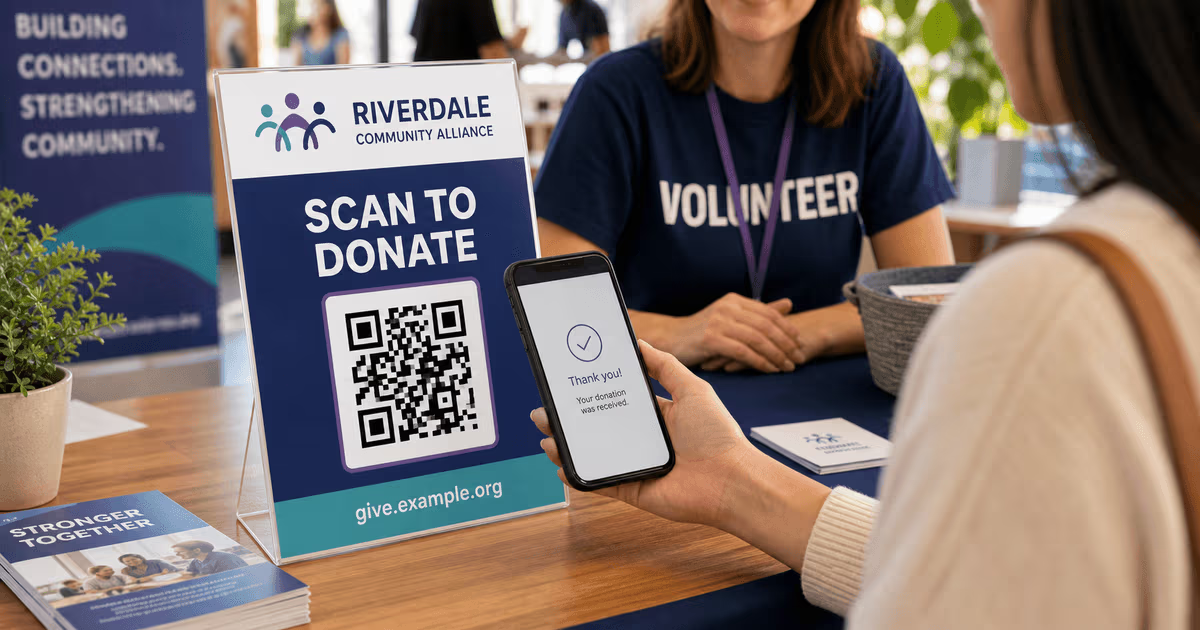
Charities, churches, school fundraisers, and community organizations can place PayPal QR codes on donation boxes, event programs, fundraiser flyers, and even street collection buckets. Digital donations through QR codes consistently outperform cash collection — people give more when paying digitally because there is less psychological pain than handing over physical currency. According to research from the Nonprofit Source, average online donation amounts run 2 to 3 times higher than cash donations. Add suggested amounts to the call-to-action: 'Scan to donate — $10, $25, $50, or any amount.'
Restaurants and Cafes
Place a PayPal QR code on the check presenter, table tent, or receipt. Diners scan and pay without waiting for the server to run a card. This speeds up table turnover and reduces card processing hardware costs. For tip collection, create a separate QR code with suggested tip amounts. Food trucks benefit especially — a PayPal QR code on the ordering window means you can take payments without a card reader even in areas with spotty internet connectivity.
Events, Conferences, and Ticketing
Event organizers can use PayPal QR codes for on-site ticket purchases, merchandise sales, raffle tickets, and drink tokens. Print a QR code on the event banner, booth signage, or wristband distribution table. For charity galas and silent auctions, each auction item can have its own QR code linking to a PayPal payment page with the winning bid amount. For wedding-related payments, see our guide on QR codes for wedding monetary gifts.
Invoices and Billing
Embed a PayPal QR code at the bottom of every invoice — paper or PDF. When the client receives the invoice, they scan the code and pay in one action rather than navigating to PayPal, looking up your email, entering the amount, and adding a reference number. For recurring invoices, use a dynamic QR code that you update each billing cycle with the new payment amount. This turns a multi-step payment process into a single-scan action.
Street Performers, Buskers, and Tip Jars
The tip jar is going digital. Street performers, musicians, baristas, and hairdressers are replacing (or supplementing) physical tip jars with QR code signs. A simple printed card reading 'Enjoyed the show? Scan to tip' with a PayPal QR code lets audience members contribute even when they carry no cash. Display multiple payment QR codes (PayPal, Venmo, Cash App) so the tipper can choose their preferred platform.
PayPal QR Code Fee Breakdown: What You Actually Pay
Transaction fees are one of the most important factors when choosing a payment QR code platform. PayPal's fee structure has multiple tiers depending on the payment method, transaction type, and location. Here is a comprehensive breakdown of what PayPal charges for QR code payments as of 2026, compared to the alternatives.
Transaction Type Comparison
| Transaction Type | PayPal Rate (US) | Notes |
|---|---|---|
| In-person QR code (PayPal Business) | 1.90% + $0.10 | Promotional rate for eligible merchants; verify on paypal.com |
| PayPal.me (Friends & Family) | 0% (domestic) | No fee if funded by PayPal balance or bank; card-funded may differ |
| PayPal.me (Goods & Services) | 2.99% + $0.49 | Buyer protection included; no seller protection for F&F |
| PayPal standard online | 2.99% + $0.49 | Standard rate for online transactions |
| PayPal international | Standard rate + 1.50% | Additional cross-border fee |
| PayPal Zettle (in-person) | 2.29% + $0.09 | Requires Zettle hardware and app |
| Chargebacks | $20 per dispute | Waived if you win the dispute |
The Friends and Family Trap: Accepting payments as 'Friends and Family' to avoid the 2.99 percent fee is tempting but risky. Friends and Family payments have no seller protection — if the buyer disputes the transaction with their bank, PayPal cannot help you. For any business transaction, always use a business account with Goods and Services or the PayPal Business QR code. The 1.90 percent in-person QR rate is the best of both worlds: lower fees than standard rates with full seller protection.
Calculating Your Real Cost: For a $50 sale using the PayPal Business QR code at the 1.90 percent rate, you pay $0.95 + $0.10 = $1.05 in fees, receiving $48.95. The same sale through Square would cost $1.30 + $0.10 = $1.40. Through Cash App, the fee would be $1.38. PayPal's in-person QR rate is genuinely competitive for small and mid-size transactions. For high-volume businesses processing over $10,000 per month, contact PayPal about volume-based pricing or consider Stripe's custom pricing tiers.
Fee Reduction Tips: To minimize fees, encourage customers to pay from their PayPal balance or bank account rather than a credit card (PayPal occasionally charges less for balance/bank-funded transactions). Use the in-person QR code feature in the PayPal Business app rather than sending invoice links (which carry the higher online rate). Process all in-person payments through QR codes to qualify for the promotional rate rather than using manual card entry, which carries the standard online rate.
Security, Fraud Prevention, and Buyer/Seller Protection
Payment QR codes introduce unique security considerations that differ from traditional card transactions. Understanding PayPal's security model — and the threats specific to QR payments — protects both you and your customers.
PayPal's Built-In Security
PayPal transactions are encrypted end to end. Buyers never share their credit card number, bank account, or financial details with the seller. PayPal acts as an intermediary, shielding both parties. Every PayPal Business transaction includes buyer protection (up to 180 days to file a dispute) and seller protection (for eligible transactions where the seller can provide proof of delivery or service). Two-factor authentication (2FA) adds an additional layer for both buyer and seller accounts.
QR Code-Specific Threats
The primary security risk with payment QR codes is 'QR code overlay' or 'quishing' attacks. A bad actor places a sticker with their own QR code over your legitimate payment QR code, redirecting payments to their account. To prevent this: (1) use tamper-evident printing on your QR display — laminate or encase the code in clear acrylic, (2) regularly verify your QR code by scanning it yourself, (3) check that the payment page shows your business name, not someone else's, and (4) use a dynamic QR code from QRLynx so the redirect URL is short and recognizable (customers can verify the URL before paying).
Protecting Your PayPal Account
Enable two-factor authentication on your PayPal account immediately if you have not already. Use a dedicated business email for your PayPal Business account — not your personal email. Set up instant payment notifications so you receive an alert every time a payment is received, which helps you spot unauthorized transactions quickly. Review your PayPal account activity weekly and report any suspicious transactions within 60 days to maintain full dispute eligibility.
Customer Education
Help your customers feel secure when paying via QR code. Add a small note near your QR code: 'Secure payment via PayPal — your financial details are never shared with us.' For higher-value transactions, offer to show the customer that the QR code resolves to your verified PayPal business page before they confirm the payment. Transparency builds trust, especially with customers who are new to QR code payments.
International Considerations
If you accept payments from international customers, be aware that PayPal's currency conversion rates include a 3 to 4 percent spread above the mid-market exchange rate. For large transactions, advise international customers to pay in your currency (letting their own bank handle conversion) rather than allowing PayPal to convert, which typically yields a better rate. Also verify that your PayPal account is set up to accept payments in the relevant currencies — you may need to add currency balances in your PayPal settings.
Advanced Strategies: Tracking, Analytics, and Optimization
A PayPal QR code is not just a static payment link — when combined with dynamic QR codes and analytics, it becomes a measurable business tool that you can optimize over time.
Scan Analytics with Dynamic QR Codes
When you create your PayPal QR code as a dynamic code with QRLynx, every scan is tracked: timestamp, device type (iOS vs Android), approximate location (city-level), and browser or app used. This data answers critical business questions. Which of your three market locations generates the most QR code payments? Do more customers scan on weekday lunches or weekend dinners? Are iPhone users or Android users more likely to complete the payment? Use this data to optimize your QR code placement, marketing, and staffing decisions.
A/B Testing Payment Flows
Create two dynamic QR codes with different destinations — one linking to your PayPal.me page with a pre-filled amount and another linking to a PayPal invoice or checkout page. Track which version generates more completed payments. The QR code with the higher conversion rate becomes your default. You can also test different call-to-action phrases, QR code colors, and placement positions to find the combination that maximizes scans and payments.
Multi-Location Tracking
If you operate in multiple locations (multiple market stalls, restaurant locations, or event booths), create a separate dynamic QR code for each location pointing to the same PayPal payment link. Label each code in your QRLynx dashboard: 'Market - Saturday Portland,' 'Market - Sunday Beaverton,' 'Food Truck - Weekday Downtown.' Now you can compare payment volume across locations without any changes to your PayPal setup — the analytics are in the QR layer, not the payment layer.
Seasonal Campaigns
For seasonal promotions, holiday sales, or limited-time offers, create time-bound QR codes with QRLynx's expiry rules. Set the QR code to redirect to your PayPal payment page during the sale period, then automatically redirect to a 'Sale has ended — visit our store for current offers' page after the promotion closes. This prevents confused customers from scanning an outdated promotional code weeks or months later.
Combining with Lead Capture
For B2B services and high-value products, combine your payment QR code with a lead capture form. The QR code first directs to a landing page where the customer enters their name and email, then proceeds to PayPal payment. This way, even if the customer abandons the payment, you have their contact information for follow-up. QRLynx's lead form feature makes this workflow straightforward — capture the lead, then redirect to your PayPal payment link.
Design and Printing Best Practices for Payment QR Codes
A well-designed payment QR code is scanned and trusted. A sloppy one is ignored. Follow these proven guidelines to maximize scan rates and payment conversions.
Size Recommendations by Context
For countertop displays and table tents, print your QR code at minimum 5 cm x 5 cm (2 x 2 inches). For wall-mounted signage at checkout, 8 to 10 cm (3 to 4 inches) works best. For banners and outdoor signs, scale up to 15 cm (6 inches) or larger depending on the expected scanning distance — the rule of thumb is that the QR code should be at least one-tenth the scanning distance (a 3-meter scanning distance requires a 30 cm code). Always print at 300 DPI or higher. For comprehensive size guidelines, see our complete QR code creation guide.
Branding and Trust Signals
Use PayPal's brand blue (#003087) for the QR code foreground to instantly signal that this is a PayPal payment code. Add the PayPal logo to the center of the code. Include the PayPal wordmark or 'Powered by PayPal' text below the code. These trust signals reassure customers that the QR code is legitimate and that their payment is protected by PayPal's buyer protection policies. Always maintain a white or very light quiet zone (margin) of at least 4 modules around the QR code for reliable scanning.
Call-to-Action Phrasing
The text around your QR code directly impacts scan rates. Use clear, action-oriented language: 'Scan to pay with PayPal,' 'Pay here — quick and secure,' 'No cash? Scan to pay,' or 'Scan, tap, done.' Avoid technical jargon or ambiguous wording. For tip jars, use 'Enjoyed our service? Scan to tip.' For donations, use 'Support our cause — scan to donate.' If you accept a specific amount, state it: 'Scan to pay $25.' Testing shows that QR codes with explicit calls to action receive 30 to 40 percent more scans than codes without any accompanying text.
Material and Durability
For outdoor or high-traffic indoor use, print on waterproof material or laminate the QR code. Avoid glossy surfaces that create glare under overhead lighting — matte finishes scan more reliably. For countertop use, an acrylic stand protects the code from spills and wear. For food trucks and outdoor vendors, consider a retractable banner or a weatherproof placard that can withstand rain and direct sunlight without fading.
Frequently Asked Questions About PayPal QR Codes
How do I create a PayPal QR code for free?
Copy your PayPal.me link (paypal.me/YourName) and paste it into a free QR code generator like QRLynx. QRLynx's free tier lets you create up to 3 dynamic QR codes with scan tracking. You can also generate a basic PayPal QR code directly inside the PayPal or PayPal Business app for in-person payments at no cost.
Does the customer need the PayPal app to scan a PayPal QR code?
It depends on the type. If your QR code links to a PayPal.me URL or a PayPal checkout page, the customer can pay through their phone browser — no app required. If you use PayPal's native in-app QR code (generated in the PayPal Business app), the customer needs the PayPal or Venmo app to scan and pay.
What fees does PayPal charge for QR code payments?
PayPal's in-person Business QR code currently charges a promotional rate of approximately 1.90 percent plus a fixed fee per transaction for eligible US merchants. PayPal.me payments sent as Friends and Family are free (domestic). PayPal.me payments sent as Goods and Services carry the standard 2.99 percent plus $0.49 fee. Always check PayPal's current pricing page for the latest rates.
Can I use a PayPal QR code for international payments?
Yes. PayPal operates in over 200 countries and territories and supports 25 currencies. International QR code payments incur the standard transaction fee plus a cross-border fee of approximately 1.50 percent. Currency conversion adds an additional spread of 3 to 4 percent above the mid-market rate. For better exchange rates, ask the customer to pay in your home currency.
Is it safe to accept payments via QR code?
Yes, PayPal QR code payments are encrypted and do not expose the buyer's financial details to the seller. PayPal's buyer and seller protection policies apply to eligible QR code transactions. The main risk is QR code tampering (someone placing a fake code over yours), which you can prevent by laminating your QR display and regularly scanning it yourself to verify it still points to your PayPal page.
Can I create a PayPal QR code for a specific amount?
Yes. Append the amount to your PayPal.me link: paypal.me/YourName/50 creates a pre-filled $50 payment. The customer can still change the amount before confirming. For the PayPal Business in-app QR code, the customer enters the amount on their phone after scanning. For fixed-price items, the pre-filled PayPal.me approach saves the customer a step.
What is the difference between PayPal.me and PayPal Business QR codes?
PayPal.me is a personalized URL that opens in a web browser — no app needed. PayPal Business QR codes are generated in the PayPal Business app and require the customer to have the PayPal or Venmo app. Business QR codes typically have lower transaction fees (1.90 percent vs 2.99 percent) and are designed for in-person commercial transactions with seller protection.
Can I track how many people scan my PayPal QR code?
PayPal itself does not provide scan analytics. However, if you create your PayPal QR code using a dynamic QR code platform like QRLynx, every scan is tracked with timestamp, device type, location, and browser data. This lets you measure how many people scanned your code, when peak scanning times occur, and which locations generate the most interest.
Should I use a static or dynamic QR code for PayPal payments?
Use a dynamic QR code for any business application. Dynamic codes let you change the PayPal link without reprinting, track scan analytics, set expiry dates, and add password protection. Static codes are fine for personal one-time use where you will never need to change the link and do not need tracking. See our static vs dynamic QR codes guide for a detailed comparison.
Can I use a PayPal QR code at a farmers market without internet?
The seller does not need internet — the printed QR code works offline. However, the customer needs mobile data or WiFi to complete the PayPal payment on their phone. In areas with poor connectivity, consider displaying your QR code in advance so customers can scan and complete payment when they have signal. Most farmers markets in urban and suburban areas have adequate cellular coverage for QR payments.
How do I accept both PayPal and Venmo with one QR code?
PayPal's in-app Business QR code automatically accepts both PayPal and Venmo payments — the customer can choose which app to pay with when they scan. If you use a PayPal.me link QR code, only PayPal payments are supported. For maximum flexibility, create separate branded QR codes for PayPal, Venmo, and Cash App and display them together on a single sign.
Can I add a PayPal QR code to my invoices?
Yes. Generate a QR code from your PayPal.me link (with the invoice amount pre-filled) or from a PayPal invoice share link, then embed it at the bottom of your PDF or printed invoice. Add text like 'Scan to pay this invoice instantly' below the code. For recurring invoices with changing amounts, use a dynamic QR code that you update each billing cycle to reflect the current balance due.